A quarter-century of supporting Asian Pacific Islander students
The Pan-Asian American Community House is marking 25 years of fostering community, inspiring leaders, and providing a home away from home.
Twenty-five years ago, the Pan-Asian American Community House (PAACH) opened its doors as a space to support Penn’s Asian Pacific Islander student communities and anyone interested in their diverse cultures and experiences.
Since then, it has provided both a physical space and a support network for students from Asia and of Asian descent, offering comfort, advice, counseling, food, and just a place to relax.
PAACH is also a place for cultural events and community celebrations, including student mixers, local trips, and workshops covering food, festivals and art. The center also supports events such as Asian Pacific American Heritage Week and groups highlighting music, dance, theatre, and spirituality.
“I think all of the students would agree with me when I say that PAACH is almost like a second home,” says fourth-year Megan Chan, chair of the Asian Pacific Student Coalition. “It’s more than just a cultural center.”
Alumnus Franklin Shen, an early PAACH founder who graduated in 2003, says he welcomed the community atmosphere and support. “I could find food, community, advice, mentorship,” Shen says. “My parents never went to college, so there was information about financial aid, how to navigate university life, how to study. PAACH really helped fill the gaps.”
Leadership: Meeting a ‘major challenge’
PAACH opened in November 2000, a year after students led a campus-wide campaign for the creation of a resource center. Programs soon followed to strengthen student leadership, support incoming first-years, collaborate with local schools, and provide mentorship to undergraduates.
Today, a significant focus of PAACH is to help cultivate the next generation of Asian Pacific Islander leaders, says PAACH Director Mei Long. “One of the major challenges facing the API community is that you rarely see us in senior leadership positions across all industries,” she says.
The center’s Asian Pacific American Leadership Initiative (APALI), which began in 2001, is one of the center’s longest-standing programs. Through a weekend retreat and facilitator-led sessions, APALI empowers students to explore their identities and strengthen leadership skills.
25th-anniversary event
At its anniversary celebration earlier this month, with the support of alumnus Chris Davies, PAACH announced a new API Leadership Series, to connect alumni and students through dialogue and mentorship. It features a fall fireside chat and a spring panel highlighting API leaders across industries, fostering inspiration and growth.
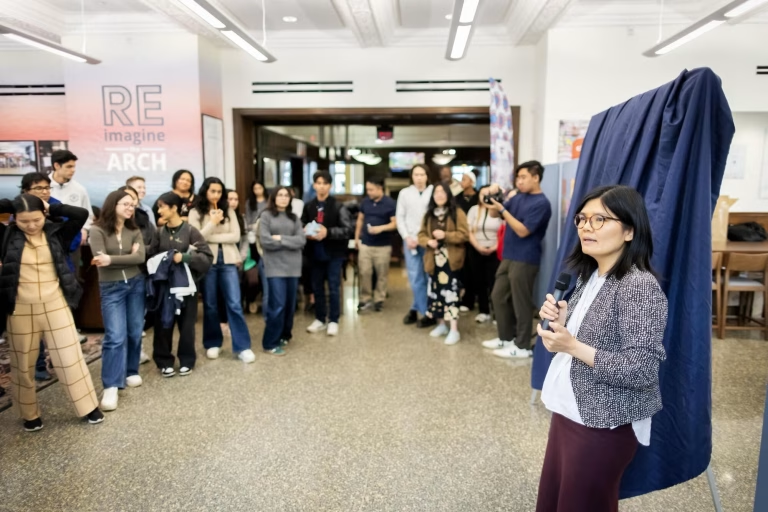
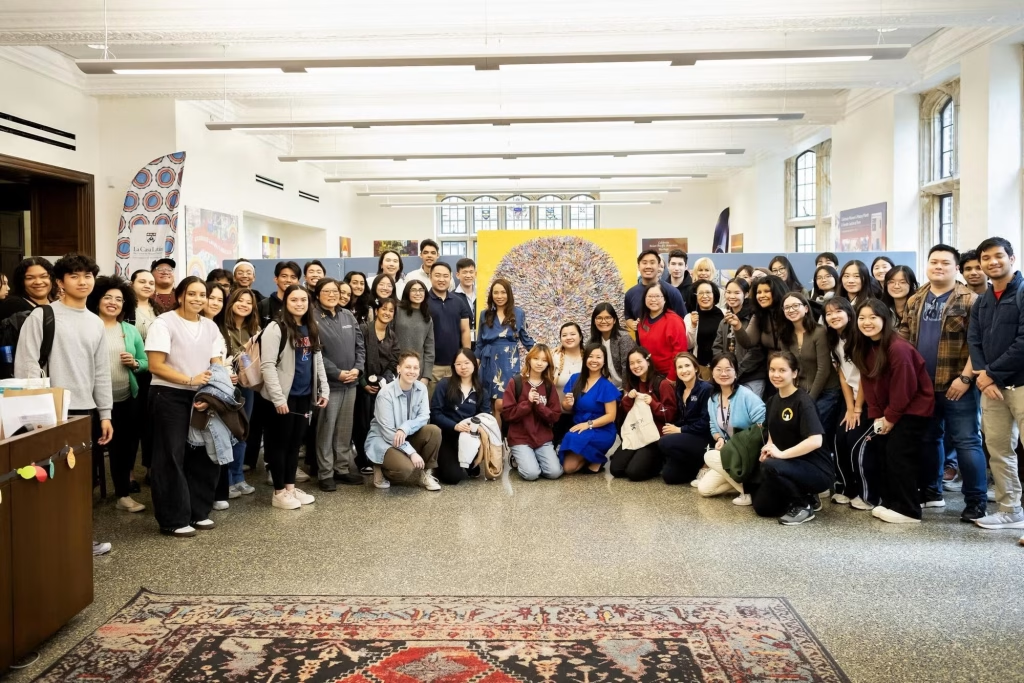
Nearly 200 guests came to the event, with remarks from Provost John L. Jackson Jr., Vice Provost for University Life Hikaru Kozuma, and Long. There was also an alumni panel and performances by the Penn Lions and Penn Atma.
In recent years, PAACH has also put significantly more resources and attention into supporting the graduate student population so that they see PAACH as a space for them as well, Long says. “We should support students at all degree levels,” she says.
Chan finds herself at PAACH almost daily. “It’s not just the support they’ve given through events and programming and just being there,” says the business analytics and marketing major in the Wharton School from Philadelphia. “I can feel the care for all of us as students.”
Growing diversity: ‘A fantastic job’
Shen remembers visiting PAACH for the first time, then located on the first floor of the ARCH building. “The thing that stood out to me was free food,” he says, laughing.
Before PAACH was founded, Shen says, the Asian Pacific community didn’t have a unified network or even a place to gather. After it came about, for many individual students, including himself, it became a “living room away from home,” he remembers. “That’s where I spent time, entertained, met people, arranged meetings. Any free time I had, I spent at PAACH.” He went on to participate in APALI and lead the Chinese Student Association.
The Asian-Pacific Islander community is very diverse, both at Penn and in the broader world. Second-year Simon Thomas, a vice-chair of the Asian Pacific Student Coalition who grew up in Kigali, Rwanda, as a “third-culture kid,” says he “really enjoyed that diversity” when he came to Penn.
“We are such a broad range of cultures that it’s very impressive and honestly quite daunting,” he says. “When you think about how many cultures PAACH represents, they do a fantastic job with trying to encompass students from all regions of the API community,” says Thomas, a business economics and public policy and finance major from the Wharton School.
Several student groups affiliated with PAACH are engaged in service efforts, both close to campus and abroad, further spreading the community’s reach. These include Asian Students Promoting Identity, Reflection, and Education, or ASPIRE, a PAACH student-led outreach program for local high school students, and an undergraduate mentoring program, Promoting Enriching Experiences & Relationships, as well as APALI and others. “It’s great to welcome new people into the space and just get to show them what it’s all about,” Chan says.
Thomas praises the PAACH leadership and staff for their enthusiasm and warm welcomes. “Every single person who walks into that living room and goes to a PAACH event really feels at home, and really feel like they are home,” he says. “The love that the PAACH staff have for the API community, as well as the love that API students have for PAACH, really have allowed it to flourish.”
1,000 Paper Cranes: PAACH unveils new mural
Members of Penn’s Pan-Asian American Community House (PAACH) unveiled a new mural ahead of Asian/Pacific American Heritage Month in the ARCH building at an event on April 16.
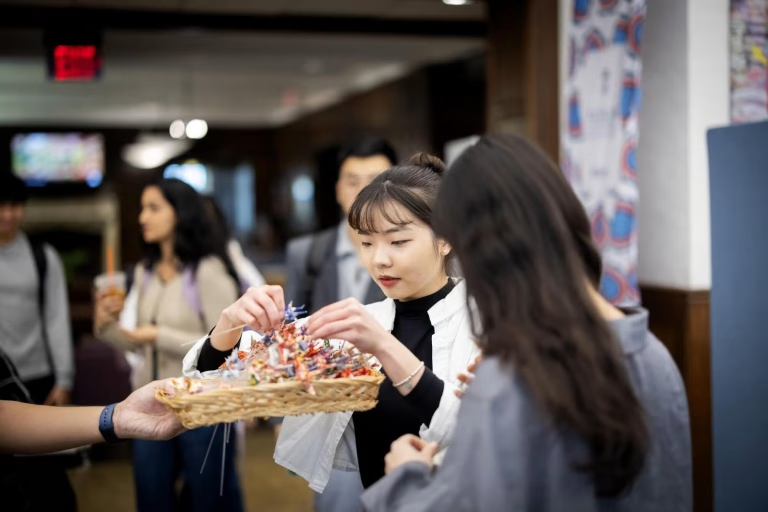
Students, faculty, and staff members gathered in the lobby at Penn’s ARCH building, passing around baskets of small origami cranes. The month of May is Asian / Pacific American Heritage Month, and the Pan-Asian American Community House (PAACH) team holds its annual mural unveiling in April as a preview event for APA heritage month. “We host the celebration before the month of May, before students leave campus,” said Mei Long, director of PAACH.
Established by Congress in 1992, APA heritage month was designated in May in recognition of two historical events: the arrival of the first Japanese immigrant to the U.S. in May 1843, and the completion of the transcontinental railroad in May 1869. Standing beside the concealed mural before its reveal, Long explained why the railroad was significant: It was largely built by approximately 20,000 Chinese laborers. At its completion, the railroad cut travel time from New York to San Francisco from several months to just seven days.
“The railroad united the country and made a strong foundation for the economic prosperity in the years that followed,” said Long. “But the Chinese laborers suffered prejudice, abuse, significantly lower wages, and social isolation. The laborers organized strikes for better conditions.” These strikes, Long explained, “paved the way for labor rights that benefit all of us today.”
Long offered another history lesson. “PAACH is celebrating 25 years in 2025, after Penn students called for an Asian Pacific Islander cultural resource center in 2000.”
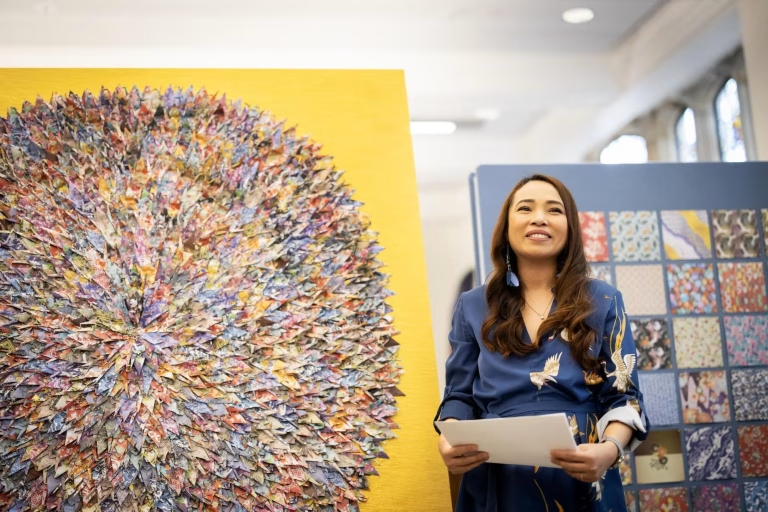
The PAACH team—Long and associate directors Vicky Faye Aquino and Daniel Hoddinott, and program coordinator Cindy Au-Kramer—asked the crowd to form a circle, count to three, and then unveiled a large canvas with a central mandala. Looking closer, 1,000 paper cranes comprise the mandala, all intricately folded with decorative origami paper.
The mural, “1,000 Paper Cranes Mandala,” is the handiwork of Aquino. “On my first day at PAACH, I noticed tiny paper cranes hung from a pillar and they provided a warm and colorful welcome to the space,” she said. In planning and designing this year’s mural, Aquino chose to create 1,000 origami cranes by hand, alone, over the course of three months.
“In Japanese culture, cranes symbolize longevity and fortune. It is believed if you fold 1,000 cranes and make a wish, your wish will come true,” explained Aquino. “The cranes symbolize hope, healing, and strength in challenging times.”
Aquino chose to mount the cranes in the shape of a mandala, which means “sacred circle” in Sanskrit. “It became a meditation for me; it takes patience, dedication, and focus. I gave birth eight months ago, and I got to share the experience with my newborn daughter. She was strapped to me while I folded cranes.”
“Despite the kind offers I accepted no help,” she added. “I was committed to doing it myself so I can have my wish granted. I’m grateful for the opportunity to bring the community together through art. Like a paper crane, we are shaped by each fold, delicate yet resilient, grounded in patience and possibility. So, give yourself a challenge, commit to it, and pour your heart into it a thousand times.”
Aquino then asked everyone to close their eyes, make a wish, and whisper it to the paper crane. After they opened their eyes, Aquino revealed her wish: “My wish is that all your wishes come true.”
This story was originally published on April 28th 2025 in Penn Today.
Writer: Tina Rodia
Photographer: Eric Sucar
‘We Bloom Together’
The mural in the ARCH building lobby represents and celebrates the diversity of Asian Americans and Pacific Islanders
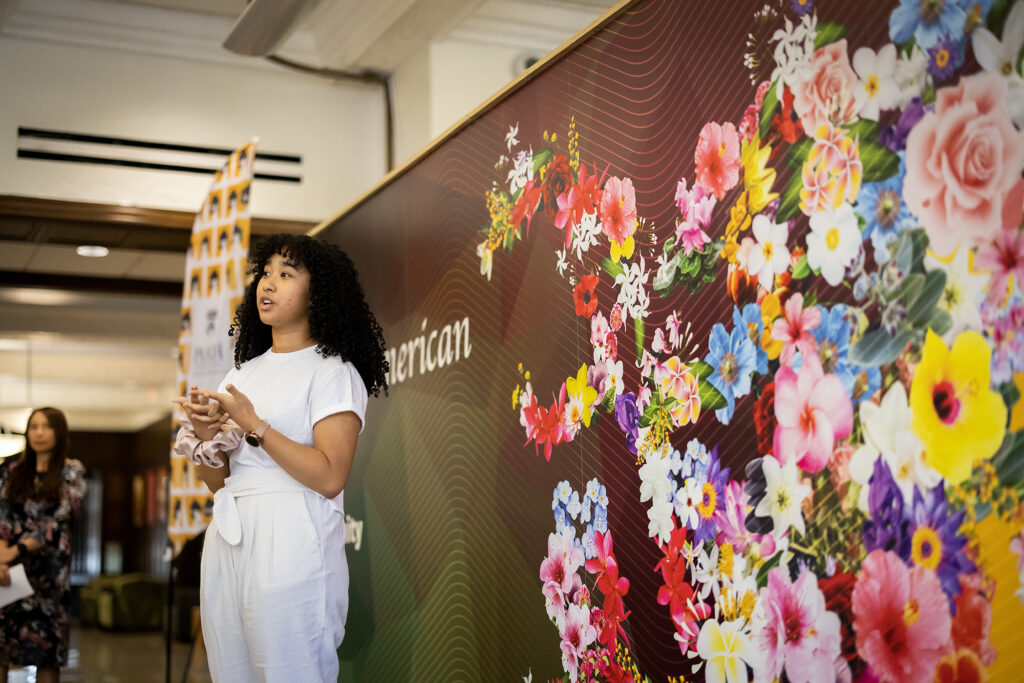
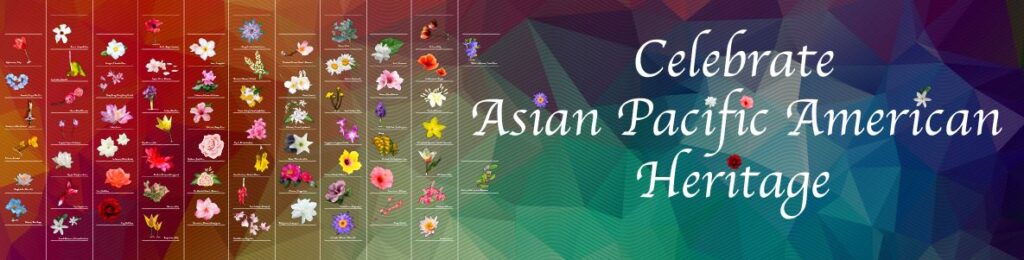
From the vivid red poppy of Turkmenistan to the golden shower tree of Thailand, all 66 Asian and Pacific Island countries are now represented on a vivid mural in the ARCH building lobby. The mural, “Planted in Different Worlds by Chance, But We Bloom Together by Choice,” was planned by the Pan-Asian American Community House (PAACH) and unveiled with student collaboration in an April 13 event.
The base of the painted mural is a woman’s silhouette and a house icon representing PAACH, said Vicky Aquino, associate director and self-taught artist. Aquino came up with the mural’s vision. PAACH, she said, “is a place where everyone can grow and bloom like flowers that have their own colors, scents, and unique beauty.”
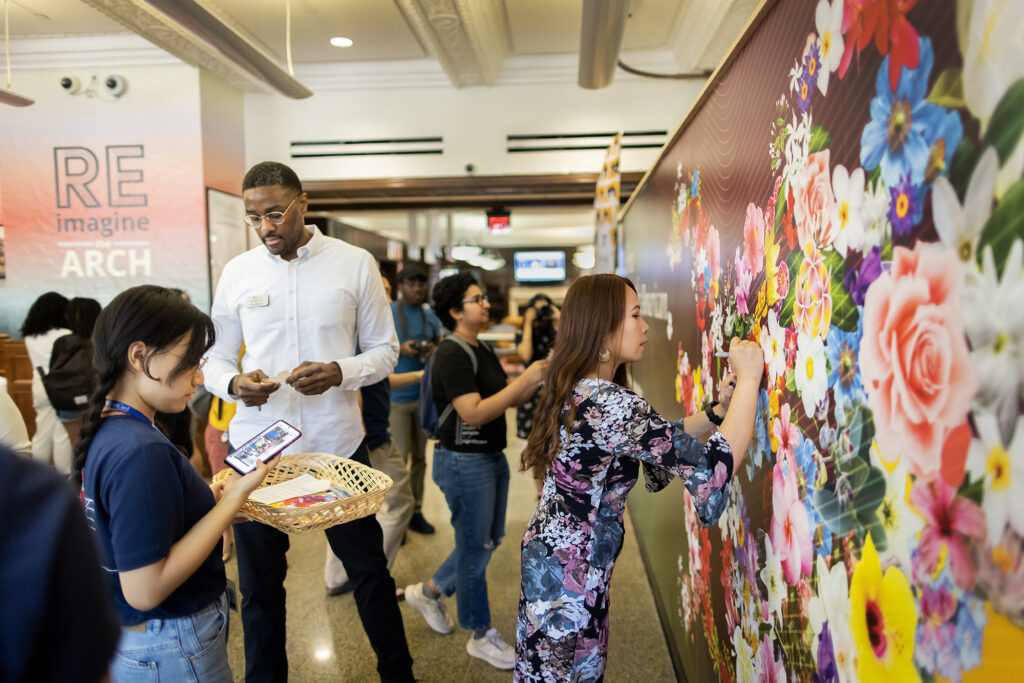
Aquino invited students to choose one or more of 66 flower decal stickers and attach them to the mural, adorning the hair and neck of the silhouetted woman with roses, lilies, plumerias, and Tahitian gardenias.
“The national flower of the Philippines is jasmine, which smells really good,” said Aquino, who chose that as her sticker. “As a Filipino American, that’s my pride. I really want to be inclusive of every single person; the best way is to represent them through the national flowers of Asia and the Pacific Islands. As a community, we should all work toward the same goal of advocating for each other, uplifting one another, and living our lives harmoniously like a field of colorful flowers.”
Grace Edwards, a second-year studying health and societies with a journalistic writing minor, worked with the PAACH team on the mural as their office assistant intern. Edwards, who grew up in Damascus, Maryland, and has since moved to Haverford, Pennsylvania, felt it was important to include everyone, she said.
Edwards identifies as biracial. Her mother is from Vietnam; her father is from Barbados. Sometimes, she says, she felt as if she had to choose. During the pandemic, there was a surge of both anti-Black racism and Asian hate, she said.
“I was able to come to terms with that and figure out what it means to be Black in America and what it means to be Asian American in America,” Edwards said. “I’m still kind of navigating that. But I’m hoping that I can use my identity to bridge these two cultures.”
The mural also incorporated a QR code that goes to a website where students can list additional AAPI organizations. “If you are part of an AAPI community, please identify that group so that we can come and reach out to you in the fall to collaborate,” said Cindy Au-Kramer, PAACH finance, operations, and program coordinator. “If you are looking to connect and you don’t know what the resources are, whether it’s Penn services, alumni connections, or community partnerships, come to us so that we can connect you.”
This project was supported by the PAACH team and program assistants; Marjan Gartland, director of creative strategy and design at University Life; and Will Atkins, associate vice provost for university life.